The 5-minute rule: how fast follow-up wins service projects

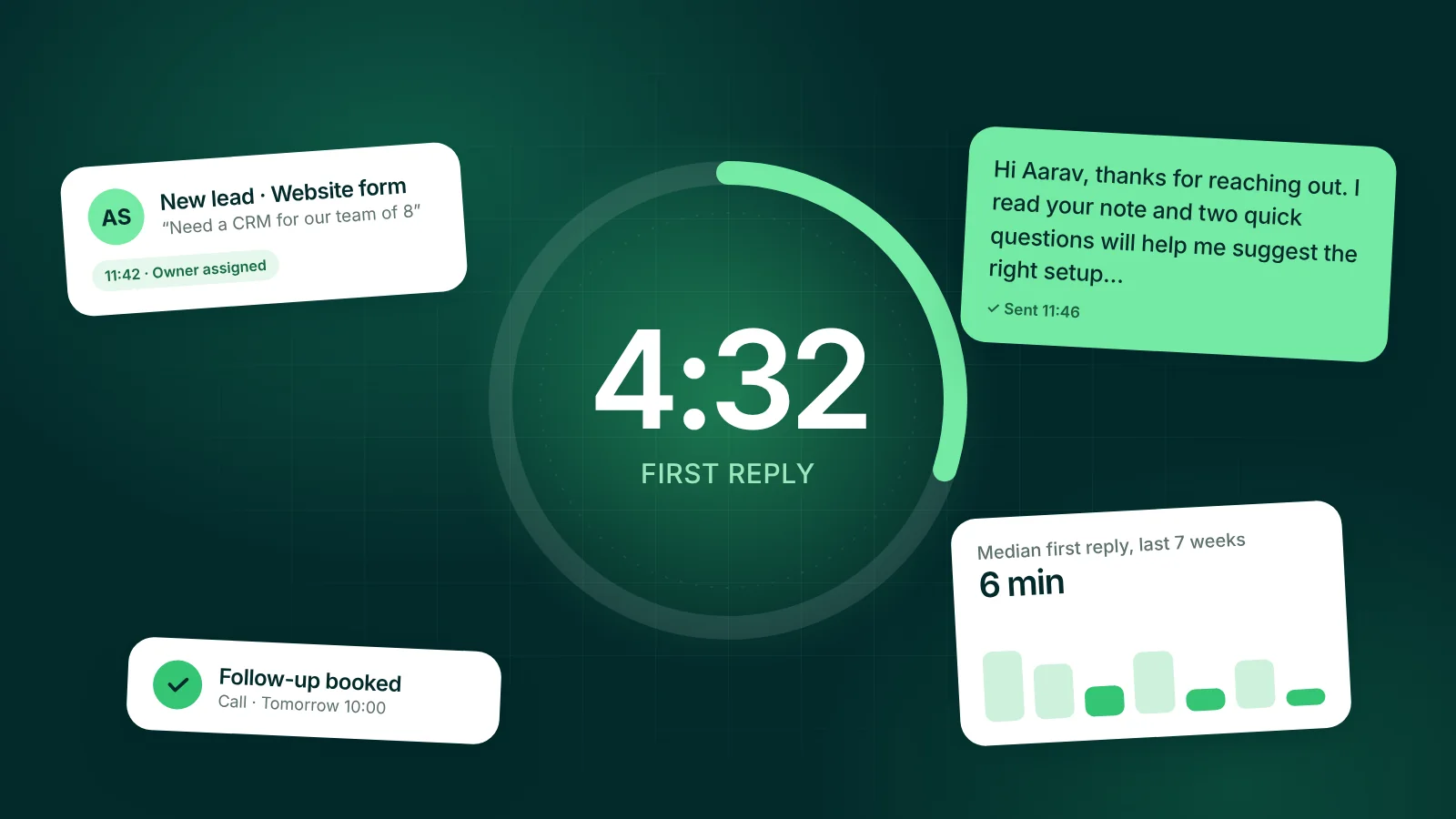
A prospect fills in your website form at 11:42 on a Tuesday. They have also messaged two other providers. By 11:50 one of you has replied with a friendly, specific message. By 4 pm another has sent a generic “thanks, we will get back to you”. You are the third, and you reply the next morning.
Nobody did anything wrong. But the project will probably go to whoever sounded most interested first. In service businesses, where the buyer is trusting a stranger with money and deadlines, the first useful reply sets the frame for everything that follows.
Why speed matters more in services than in products
When someone buys a product they can compare specifications. When they buy a service they are comparing risk: will these people respond, understand us and deliver? A fast, thoughtful reply is the cheapest proof you can offer, because it shows exactly how you will behave once the work starts.
Speed also catches buyers while the problem is fresh. A person who has just decided to fix their website, their accounts or their site installation is in “let us sort this out” mode. A day later they are back in meetings, and your message is one of forty unread.
Step 1: make a response-time promise you can keep
Five minutes is the ideal, but it is not realistic for every team at every hour. What matters is that the promise is written down and everyone knows it. A simple version:
- During working hours: a human reply within 15 minutes.
- Outside working hours: an acknowledgement that sets a clear time, such as “I will call you at 10 am tomorrow”.
- Weekends: same as outside working hours, with one person on rotation.
A promise like this removes the daily debate about whose job it is to answer. It also gives you something to measure, which we come back to below.
Step 2: write a first reply that does three jobs
The first message is not a pitch. It has three jobs: show that a real person read the enquiry, ask the one question that moves things forward, and offer a concrete next step.
Hi {first name}, thanks for reaching out about {their need}. I read your note and it sounds like {one-line summary in your own words}.
Two quick questions so I can give you something useful: {question about scope or timeline}, and {question about budget range or decision process}?
Would a 15-minute call today or tomorrow work? Here are two slots: {slot 1} or {slot 2}.
Notice what is missing: no brochure, no price list, no paragraph about your company history. You earn those later. Right now the buyer wants to know whether talking to you will be easy.
Step 3: give every lead an owner and a next action
Slow follow-up is rarely laziness. It is usually ambiguity: three people saw the enquiry and each assumed someone else had replied. The fix is boring and effective. Every lead gets exactly one owner and exactly one next action with a due date.
This is built into how Worthit AI works. The Leads screen shows the owner and the next action for each lead, and the Today panel on your dashboard lists what is due, so nothing depends on memory. You can read more on the features page.
Step 4: collect every enquiry in one place
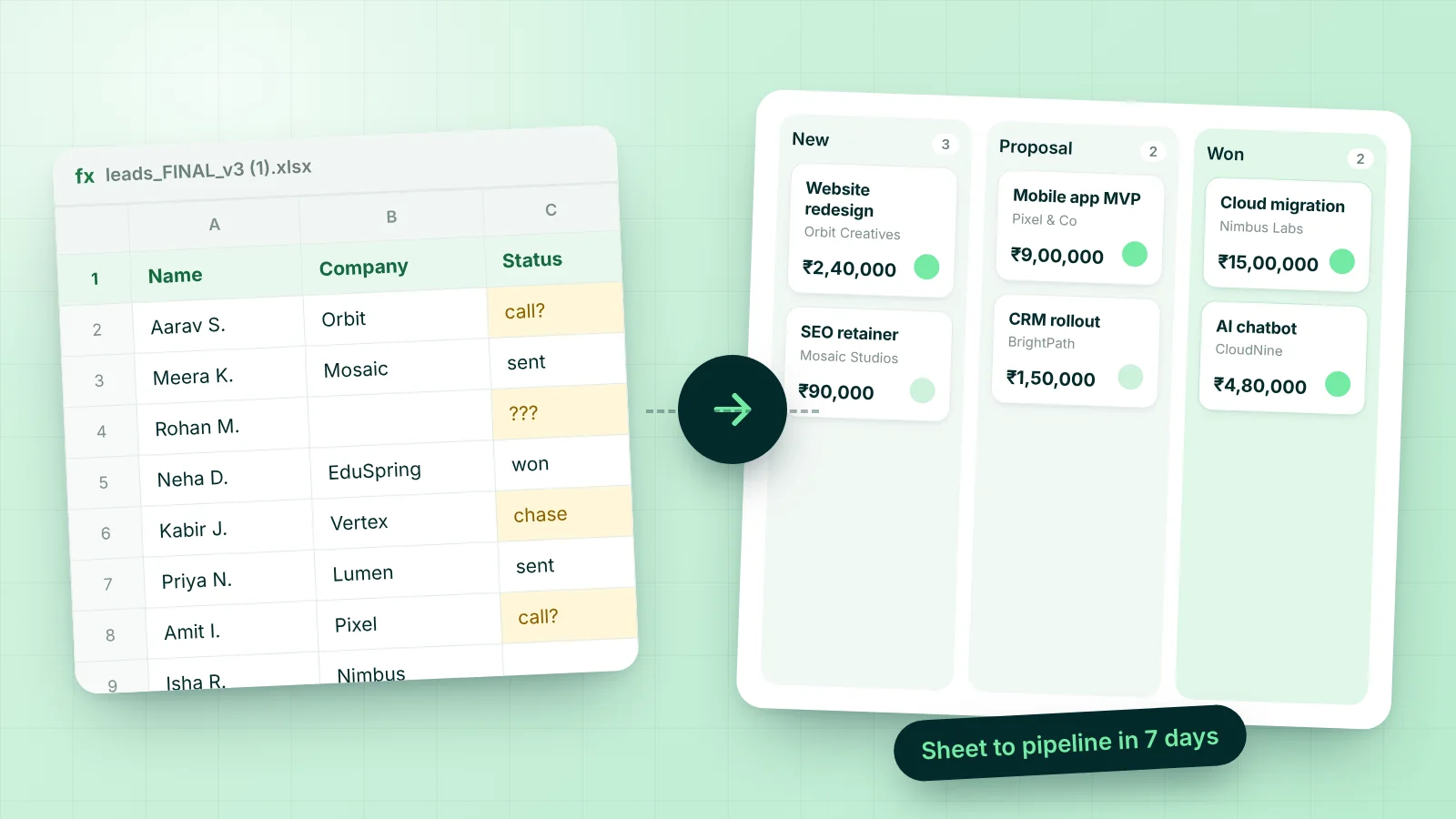
Enquiries arrive from the website form, WhatsApp, a phone call, a referral and a LinkedIn message. If each lives in a different app, the slowest channel always loses. Pick one inbox and push everything into it.
- Connect your website form with an API key so submissions land directly in Leads and trigger a notification.
- Add leads from calls and chats the moment they happen, using the quick add button.
- Tag the source on every lead so you can see which channel brings real work.
Step 5: follow up on a rhythm, not on a feeling
Most deals are not lost to a “no”. They are lost to silence after a good first call. A fixed rhythm removes the awkwardness of deciding when to chase:
- Day 0: first reply and, where possible, a call.
- Day 1 or 2: send the summary or proposal you promised.
- Day 4: a short check-in with one useful addition, such as a relevant example.
- Day 8: ask a direct question, “Is this still a priority this quarter?”
- Day 14: close the loop politely and move the lead to a nurture list.
Put each touch on the calendar as an activity with a due date. When the reminder appears, you are not deciding whether to follow up, only how.
A reminder you did not have to remember is worth more than a good intention.
Step 6: measure the one number that matters
Track the time between “enquiry received” and “first human reply”. Look at the median, not the average, because one weekend lead can distort the average. Review it for ten minutes every Monday. When the number improves, share it with the team. When it slips, ask what got in the way rather than who.
Start this week
- Write down your response-time promise and share it with the team.
- Save the first-reply template where everyone can find it.
- Decide who owns first response today, tomorrow and at the weekend.
- Connect your website form so every enquiry lands in one inbox.
- Add the follow-up rhythm to the calendar for every open lead.
None of this needs new headcount. It needs one inbox, clear ownership and a habit. If you would like to see how a CRM makes that habit easier, start a free trial or talk to us.